
00:00:00 AM
Insight
The Silent Erosion of Our Structures of Meaning
When a system can replicate what we considered our irreplaceable contribution to the world, the question ceases to be technical and becomes existential.

There is an understandable temptation to view technological advances as a natural continuation of what has always occurred. From the discovery of fire to the smartphone, humanity has experienced successive waves of transformation. But there are moments in history when the accumulation of changes reaches a critical density—instants when the speed and nature of what emerges alter not only our tools, but the very foundations of what it means to be human.
Today, we stand at one of those thresholds.
From Rigid Code to Inference
For decades, computing was deterministic. Computers were glorified calculators that executed precise instructions written by humans. “Intelligence” was, in reality, blind obedience to complex yet finite rules.
Something fundamental has shifted in recent years. Machines have begun to think and reason autonomously. It’s not that they’ve learned this magically; what has changed is the software paradigm: we’ve moved from coding explicit instructions to training models that infer latent patterns.
Herein lies the true rupture. Instead of giving the machine a rigid dictionary, we expose it to billions of examples so it can deduce for itself the underlying structure of information. Modern artificial intelligence is the result of this massive digestion.
AI doesn’t possess explicit knowledge in the human sense, but it has achieved something perhaps more functionally powerful: it has compressed the reality we all know into latent spaces. We no longer interact with systems that retrieve information from a database; we engage with far more complex and powerful systems that navigate a map of trillions of probabilities. AI has ceased to be a classification system to become an inference engine capable of handling ambiguity, context, and, for the first time, semantics.
It’s not that the machine “writes code” or “creates art”; it’s that the barrier between human intention and digital execution has dissolved. The marginal cost of cognition is plummeting toward zero.
Intelligence Takes Physical Form
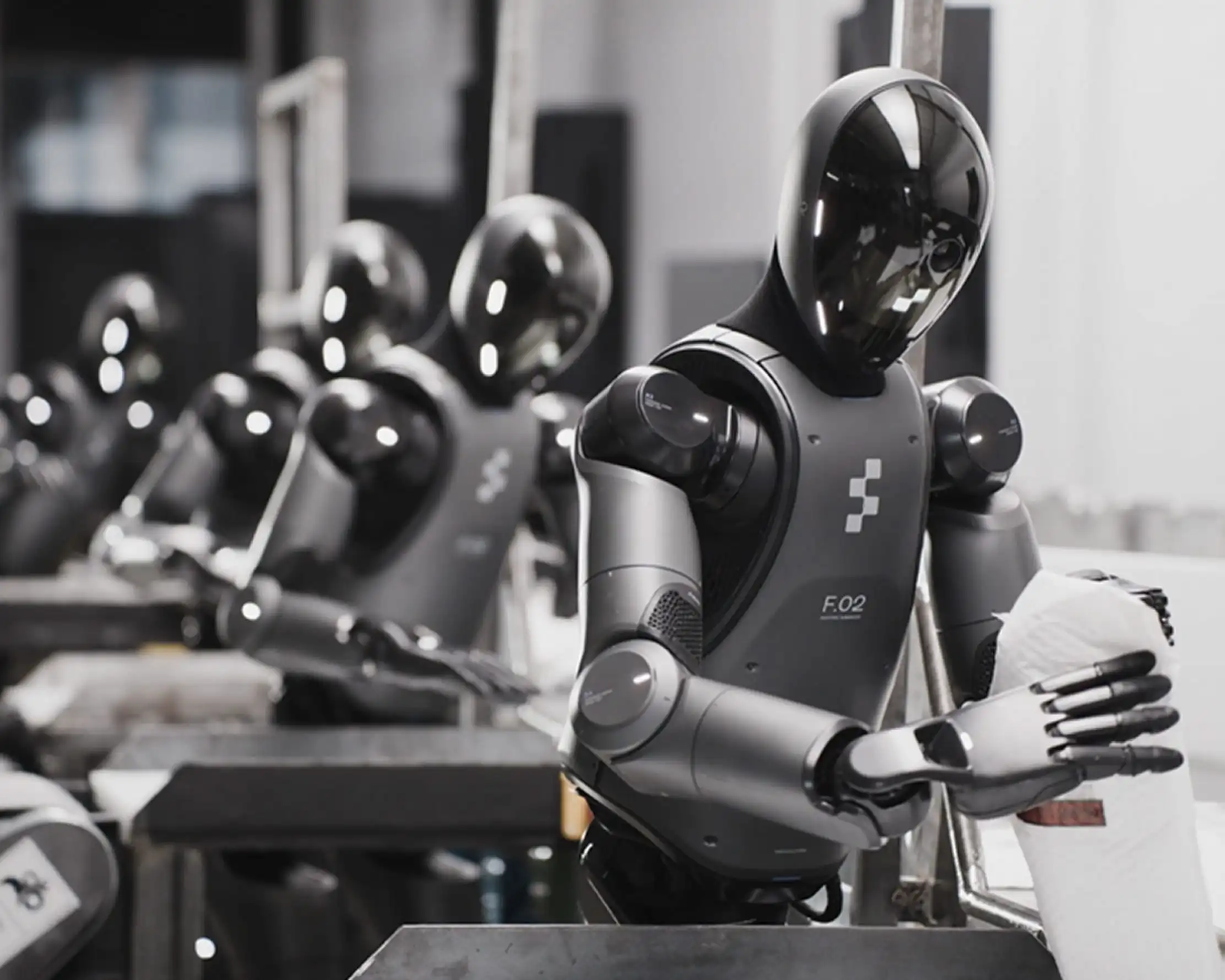
If cognitive AI has broken through the language barrier, robotics is about to break through the physical world barrier. And here too, the popular narrative gets it wrong.
The problem of robotics was never purely mechanical. We weren’t lacking better motors or longer-lasting batteries. We were lacking the “brain.” Until now, an industrial robot required a sterile environment and exact coordinates. For years, robots have only operated enclosed in factories, executing repetitive movements in controlled environments. But all of this has changed.
In robotics, too, a qualitative leap has occurred born of convergence: AI integrates into hardware, endowing it with a capacity to adapt to the physical world that was previously impossible. We are witnessing how multimodal systems integrate into machines, enabling them to understand the physics of the real world not through preprogrammed algorithms, but through learning and experience. The robot no longer needs to be told how to grasp an unknown object; it infers it.
Intelligence no longer lives solely in servers; it’s beginning to have hands, legs, and above all, agency over the physical environment.
The Erosion of Certainties
As the manifesto points out, this revolution will force us to confront multiple challenges—not only technological, but also philosophical and ethical. Perhaps one of the most unsettling is the silent erosion of our structures of meaning.
For centuries, we have tied our identity to our utility. “Being” has been confused with “doing.” Time and again, human value is defined by the capacity to process information, make decisions, and execute complex actions. But what happens when the marginal cost of those skills plummets toward zero?
We’re not facing mere job obsolescence—a recurring economic phenomenon—but a crisis of purpose.
In this space, there will be time to dissect many of the distinct challenges this wave brings with it, but this first reflection seeks to invite contemplation on one of the most immediate vertigos: the confrontation with a possible lack of meaning and the urgent need to redefine our purpose.
When a system can replicate what we considered our irreplaceable contribution to the world, the question ceases to be technical and becomes existential. If the machine surpasses us in what we believe defines us, the question is no longer just “what will I work at?”—it becomes “what am I for?”
An Invitation to Reflect with Lucidity
We must resist the easy extremes. We’re not facing a catastrophic movie script nor a technological utopia. Both narratives are narcotics that prevent us from seeing reality with precision.
The texts in this space don’t seek to generate alarm, but to invoke the necessary calm to face the inevitable. The transformation will happen, with or without our permission. The outcome is not written in the algorithm, but in the decisions we make now to confront the changes that lie ahead.
Deep reflection requires stepping out of the noise. We live in a paradox: the maelstrom of the immediate prevents us from distinguishing the anecdotal from the structural. We consume hype, not signal. This space is born precisely to pause that vertigo. The goal is to invite reflection in advance about something we will soon have to manage out of necessity.
We have already crossed the threshold. The question now is: do you dare to look, with the serenity of one who understands, at what lies on the other side?
Would you like to dive deeper into the ideas of this article?
If you have made it this far, you may have a question or feel like continuing to reflect. You can chat with a conversational assistant to dive deeper into the content.
Your conversations will be 100% private and will not be stored.